After Material
About this
Exhibition
About this
Exhibition
After Material
An exhibition curated by Max Diallo Jakobsen
ARAK Collections Curatorial Fellow, 2025–2026
Exhibition dates: 12 February – 10 April 2026
Opening: Thursday, 12 February 2026, 5:30 PM for 6 PM
Venue: University of Johannesburg
Faculty of Art, Design and Architecture (FADA) Gallery
Public programme:
Saturday, 14 February 2026, 11 AM
Max Diallo Jakobsen in conversation with Dr Sara Bint Moneer Khan,Curator of the ARAK Collection. Followed by Q&A
Artists:
Ocom Adonias, Ange Dakouo, Matt Kayem, Paul Njihia, Nabukenya Allen (Njola Impressions)
The University of Johannesburg FADA Gallery and the ARAK Collection are pleased to present After Material, an exhibition curated by Max Diallo Jakobsen as part of the ARAK Collections Curatorial Fellowship, 2025–2026. The exhibition brings together works from the ARAK Collection, a private African art collection based in Doha, Qatar.
The title After Material is drawn from the tradition of the after-poem: works of writing composed in response to another artwork or artist, marked “after” as a gesture of devotion and extension. Such poems listen closely to what has already been given and offer another form in return. Selected from the ARAK Collection, the artists assembled in this exhibition approach their materially rooted practices in this spirit. Their works are made after cloth, after plywood, after newsprint, after rubber, and after denim, intentionally attending to substances already inscribed with social, political, and economic histories, and registering what can follow from them.
In this context, the notion of the “after” is layered. It points to temporality: the afterlives of discarded matter, the states of being that emerge once a material has exhausted its use in one realm and is taken up in another. But it also carries the resonance of the French d’après, which translates more closely to “according to.” To work d’après material is to attend to what matter itself makes possible, to follow its logic rather than impose one upon it. More broadly, this exhibition also stages a reflection on the so-called material turn in modern and contemporary art and asks concretely: what may come after it?
Artists across Africa have long engaged unconventional materials and found objects as sites of formal and conceptual experimentation. These material practices were central to the work of collectives such as Laboratoire Agit’Art in Senegal and Vohou-Vohou in Côte d’Ivoire during the 1970s and 1980s—groups working against both nationalist prescriptions of cultural identity and external demands for aesthetic synthesis. Emerging from contexts marked by economic precarity inextricably linked to the imposition of Structural Adjustment Programs, political instability in newly formed nations, and the afterlives of colonial extraction, these practices interrogated material as a simultaneous economic, political, and aesthetic concern.
Critics including Okwui Enwezor and Achille Mbembe have situated such work within broader accounts of postcolonial temporality and decolonial thought. Yet institutional reception has too often reduced these practices to narratives of scarcity or mere resourcefulness, framing material innovation as necessity rather than aesthetic choice. Such reductive readings persist even as artists such as El Anatsui, Ibrahim Mahama, and Abdoulaye Konaté have secured major international recognition, alongside practitioners including Billie Zangewa and Nandipha Mntambo who continue to expand on these concerns. The artists in After Material inherit and navigate this complex terrain.
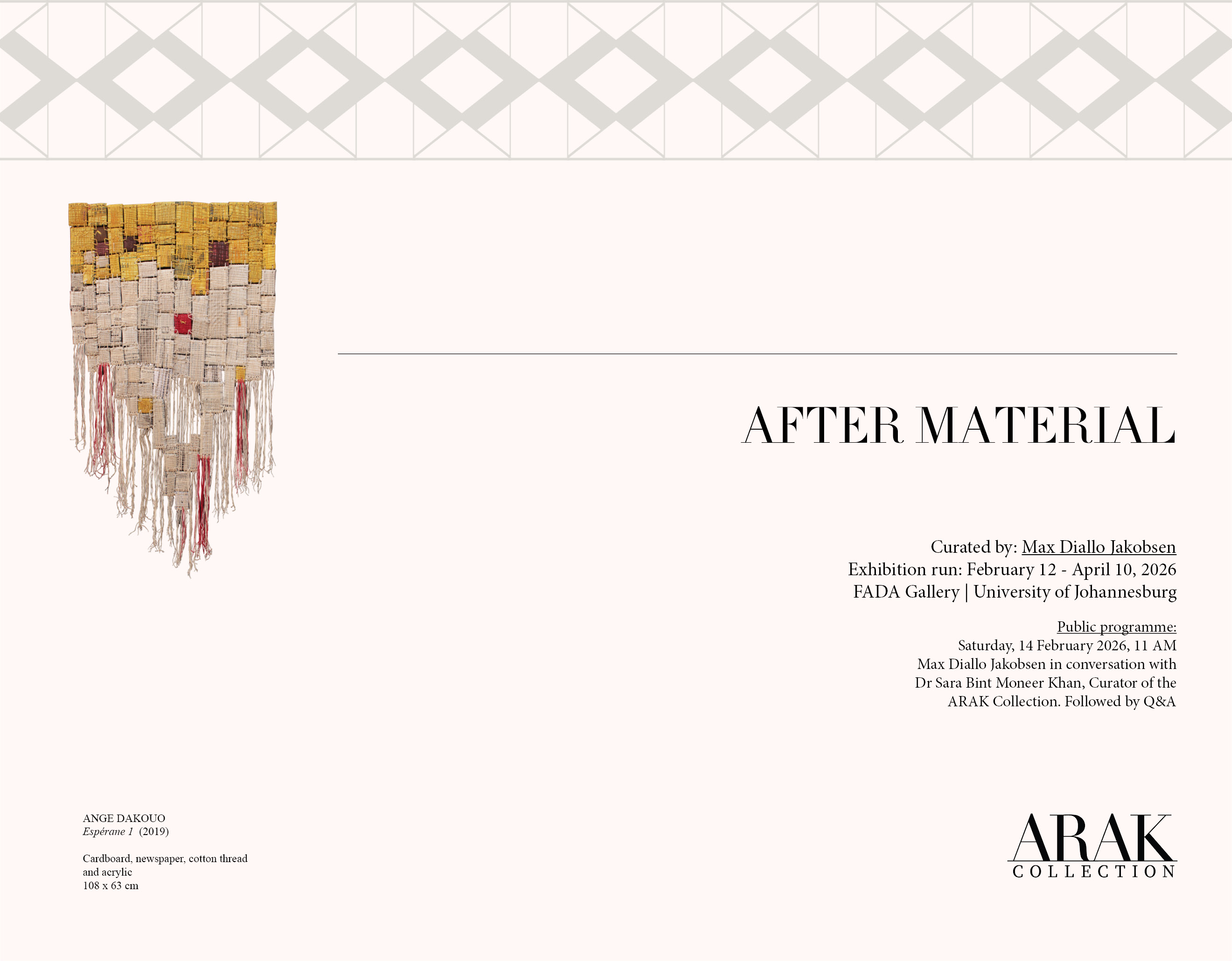
Through a selection of works from the ARAK Collection, the exhibition brings together five artists who approach materiality in distinct ways. Ocom Adonias collects Ugandan newspapers chronicling economic turbulence and transforms them into densely layered grounds for portraiture. In a similar spirit, Matt Kayem fragments and reconstructs denim, barkcloth, and kitenge—materials dense with histories of global commerce, colonial trade networks, and labour exploitation—into strikingly intimate compositions. Paul Njihia paints directly onto plywood, rendering schoolchildren and classroom scenes that measure the distance between education’s promises and its failures across the continent. Nabukenya Allen (Njola Impressions) gathers discarded flip-flops and car tyres, mass-produced commodities that become both substrate and medium in her portraiture, collapsing the distinction between surface and image. Ange Dakouo works with thread and cardboard, crafting sutured abstractions that evoke fragility and resilience in equal measure, operating as both protective devices and carriers of collective memory.
After Material contributes to ongoing curatorial and scholarly conversations about materiality in contemporary African art in South Africa, entering into dialogue with recent exhibitions such as Encounters with the (Im)material (Wits Art Museum, curated by Alison Kearney) and Matereality (Iziko South African National Gallery, curated by Andrea Lewis). The works gathered here do not celebrate materiality for its own sake, nor do they traffic in easy metaphors of transformation. They reflect, instead, on what it means to attend to the world through matter, to register the scars it carries, to trace how fragments become form, and to ask what futures might be imagined through its afterlives.
About the Curator

Max Diallo Jakobsen is a Swedish-Guinean writer, historian, and curator whose work explores the intersections of materiality, cultural history, and postcolonial modernisms. His practice examines how artistic and material forms register histories of movement and transformation, and how artists mobilise these forms as modes of political and aesthetic imagination.
His scholarship focuses on global postcolonial modernisms, particularly Guinea’s cultural revolution of the 1960s and 1970s. His undergraduate thesis at Princeton University, BLUEPRINTS, examined indigo textile traditions in Guinea and was awarded the Lawrence Stone and Shelby Cullom Davis Thesis Prize and the Henry Richardson Labouisse 1926 Prize. His writing has appeared in Tender Photo and Artsy, and he has presented at the 19th Triennial Symposium on African Art (ACASA), George Washington University, and Princeton University.
Max has curated exhibitions and contributed to projects across Africa, the Gulf, Europe, and North America. He is the inaugural recipient of the Southnord Residency Programme Award in partnership with the Lusaka Contemporary Art Center. In 2025, he served on the jury for the Southnord UP NEXT Prize and curated the exhibition of the winning artist, Ugandan sculptor Viola Nimuhamya, in Stockholm. He also served as Curatorial Assistant at Fondation Cartier pour l’Art Contemporain, Paris, on the forthcoming exhibition Ibrahim Mahama: The Harvest Season (October 2026).
Max holds an A.B. in History, African Studies, and Visual Arts from Princeton University. He lives between Conakry, Dakar, and Stockholm.
Artworks in this
Exhibition
Artists involved


.jpg)