Ideas of Freedom in the work of Michael Musyoka

.svg)


.svg)
.svg)
IMAGE: HUNTING GROUNDS 4
Ideas of Freedom in the work of Michael Musyoka
Pauline Buhlebenkosi Ndhlovu
Micheal Musyoka (b. 1986) is a Kenyan artist, living and working in Nairobi. Musyoka is mainly concerned with freedom, a theme he explores through the lens of human behaviour and by examining the things which make us either free or bound. His longstanding interest in the subject of human behaviour, enriched by his own observations, musings and experiences, informs his work. He sees his work as investigating relationships and how they function in both the public and private spheres, and by extension, how moral, religious and legal considerations place constraints on individuals and their capacity to act.
Musyoka attended Buru Buru Institute of Fine Art in Nairobi, and was able to complete his studies with the help of a patron who sponsored him. After meeting at one of the bars Musyoka worked at to help finance the cost of his education, they came to an agreement that in exchange for a selection of paintings from Musyoka each year, the patron would cover the cost of his studies. In 2013, alongside two other artists, Maina Boniface and David Thuku, Musyoka co-founded the artist collective Brush to Art Studio. In view of an economic and social climate in Nairobi which was relatively unfavourable to artists at the time, Brush to Art Studio was formed with the aim of pooling both resources and expertise. With few local patrons and collectors, and little sectoral infrastructure offering services to artists, except through the Kuona Trust and the GoDown Arts Centre, there was very little local support for artists. The collective works on a number of projects, some of which include large-scale mural paintings and providing mentorship to young, upcoming artists by sharing networks, resources, and opportunities.
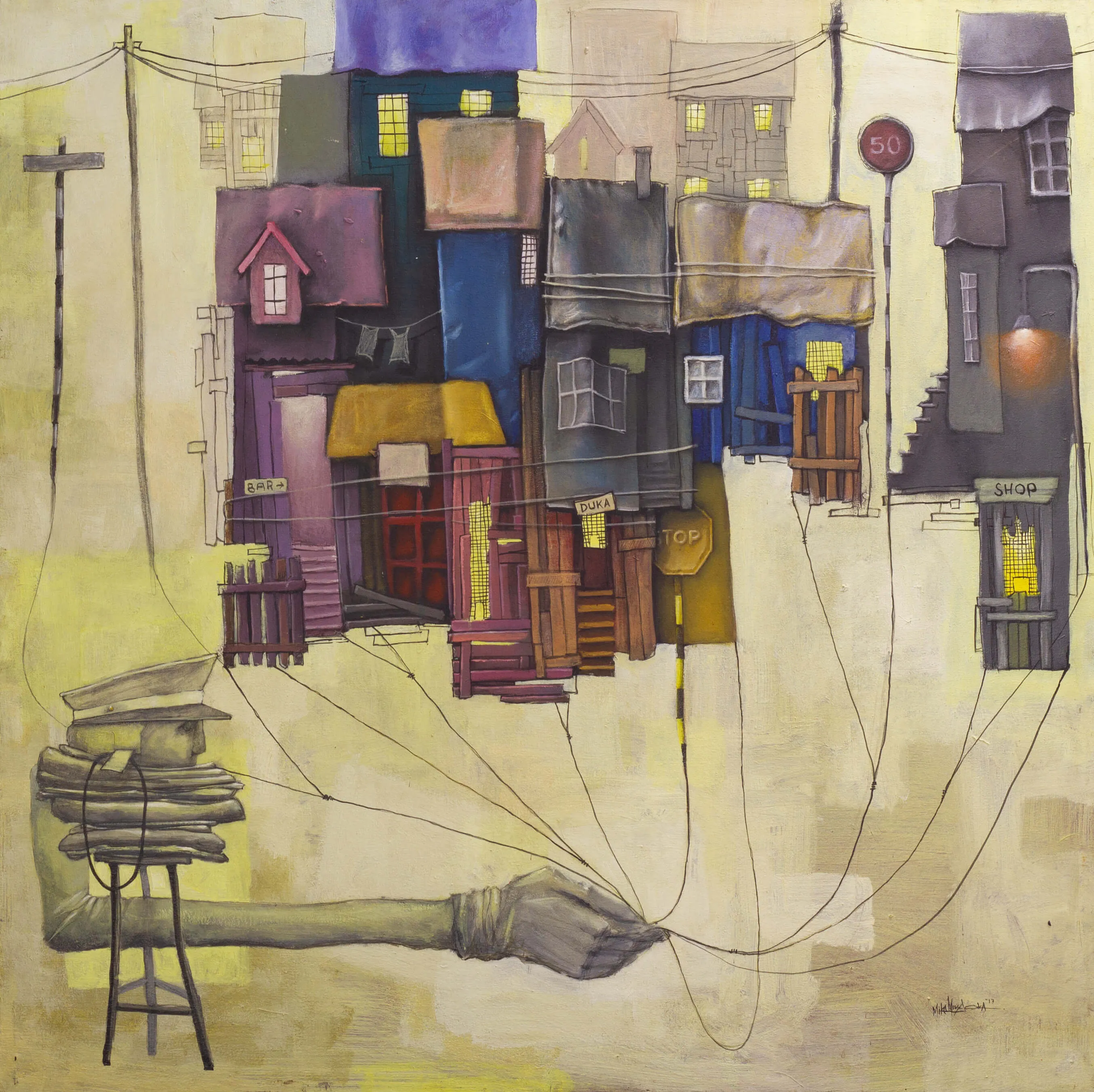
Musyoka deals with the modern idea of freedom, which includes religious freedom and civil liberties, as well as freedom of speech and political action. He delves into societal frameworks and structures, focusing on whether government, the law and punishment in society really serve to regulate human behaviour and promote positive social relation, or whether they simply restrict natural instincts and infringe on human freedoms. Some of his work in the ARAK Collection, which falls under the “Hunting Ground” series, deals with a personal incident in which he was arrested for jaywalking on his way to a concert. “Hunting Grounds #3” and “Hunting Grounds #4”, are two colourful acrylic on canvas paintings, which depict how law enforcement and carceral systems impact social infrastructure and urban mobility in Nairobi. In the former, a large hand from a police figure controls various aspects of life in Nairobi, including shops, homes, bars and small retail shops called duka that are mostly run by women and families.
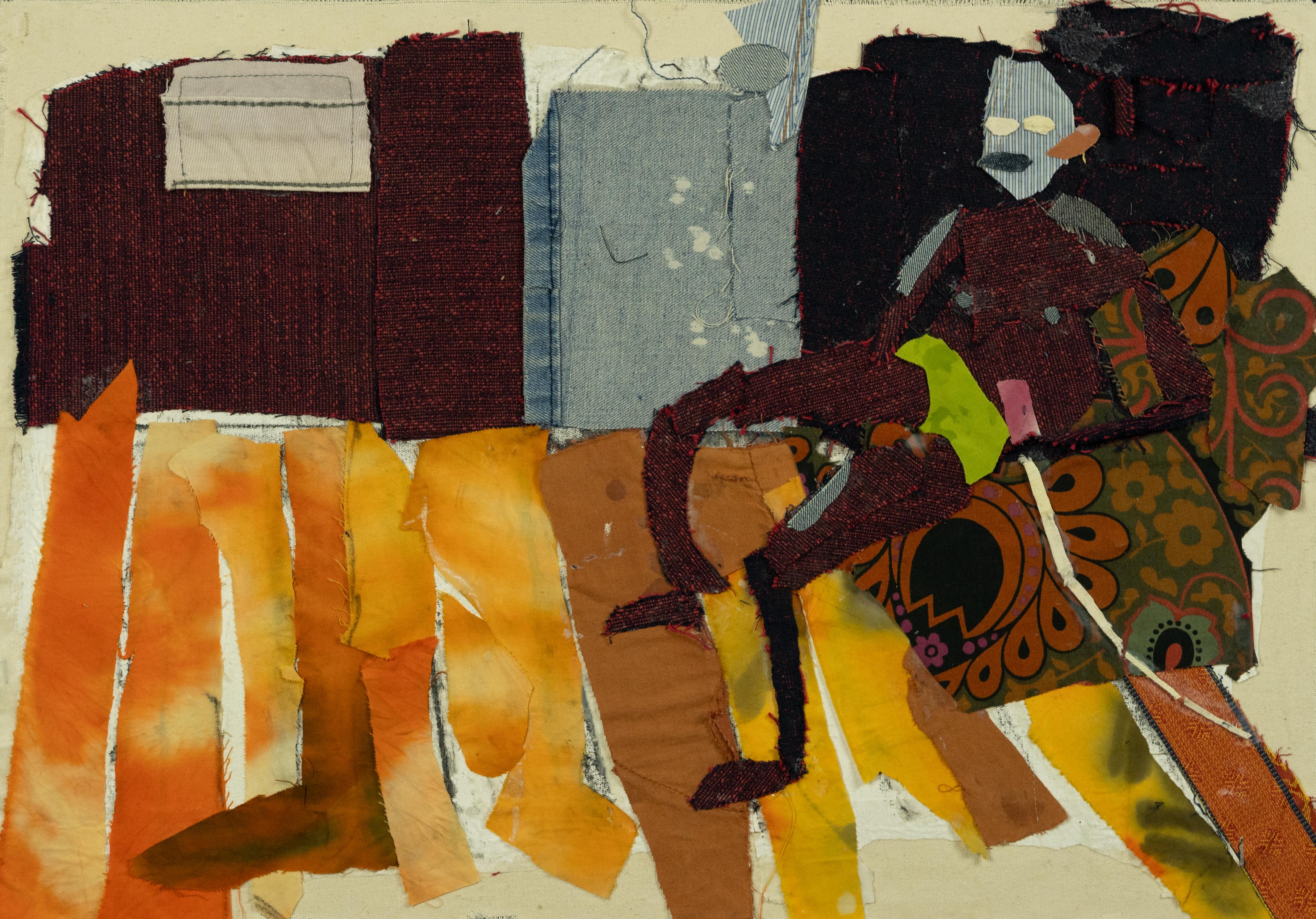
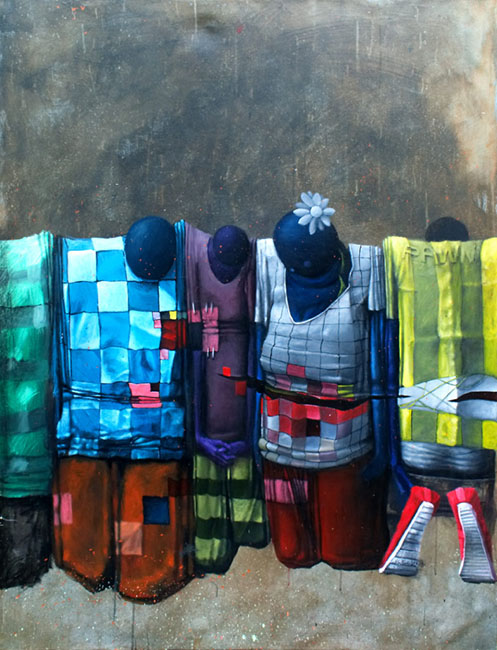
In his series, “Time & Other Constructs”, Musyoka attends the eternal apprehension posed by the question: “Is there anything that time cannot touch?” The self-representational figures, chubby and clumsy, featured in this series are all engaged in perpetual restless motion, captive to time in the same way Musyoka views human beings to be. In many ways, these figures serve as avatars for the artist’s own emotions. Through them, he is able to explore his own relationship to time and resolve some of his preoccupations with it, especially those surrounding the feeling of running out of time, as the figures are able to act out what is difficult to do in real life. They are depicted in various postures, often kneeling, sometimes slumped forwards, at times with arrows piercing their torsos, legs and feet. At other times they appear frozen while running forward, or suspended in mid-air while falling. In all these postures, there is a pervasive feeling of powerlessness, and a kind of paralysis induced by this state of foreboding and impotence or inability to act.
The placement and positioning of the figures speaks to narrow and constrictive social frameworks, and the ways in which individuals resist or struggle against change. Perhaps they serve as a reminder of how we are often resolute, inflexible, and impervious to change? Or of how we often develop an oppositional relationship to time, unable to be in time on in the moment, but rather focused on the fantasy or fear of what is past and has yet to happen.
His religious upbringing in the protestant church still has bearing on his work to some extent, contributing to both the language and constructs he deals with, as well as his ideas of divinity, eternity, morality, and animal and human nature. Musyoka investigates human nature through animal motifs. In a piece titled “The Opening Act” (this piece is not in the ARAK Collection), which depicts a clown leading a horse whose side profile is open, to reveal four skeletons tiredly propping up the horse’s hide. The skeletons are inspired by the idiom “skeletons in the closet”, and the piece is titled opening act because first appearances or first impressions often serve as trojan horses which give one impression, only for the skeletons or secrets to be revealed later. The recurring images of birds in his drawings and paintings speak to the inclination towards freedom and the propensity towards animal nature. In some instances, the birds also represent the trapped yearnings and expressions which when continually repressed, eventually compete for freedom and release.
In an interview with the artist, I invited him to engage that fantasy and indulge in his idea of freedom. Musyoka described a garden of Eden ideal, governed by freedom and abundance. When prompted to further describe what is transformed of human relationships in this utopia, he answered: “Well, they are real. Humans are not trying to one-up each other, they are not trying to compete, they are the same. Although everyone has their flaws, flaws are not judged, because those are some of the things that bring friction in relationships. Which brings me to thinking about what is a perfect relationship? For me a perfect relationship is one where there is no judgement, intimacy is real. There is probably only encouragement, encouragement that helps one lead a better life.”
His construction of paradise during our interview reminded me of a comment by Toni Morrison in a 1998 discussion on her novel Paradise. Morrison described her novel as a “rethinking that the whole idea of all paradises in literature and history…and in all the holy books are special places that are fruitful, bountiful, safe, gorgeous, and defined by those who can’t get in”. To what extent are our ideas of paradise made up of all the things we don’t have? How much of our or constructions of paradise are composed of all the things we desire?
Owing to his affinity for knowledge—including knowledge of the self—and honesty, some of his work tends towards self-portraiture. What I most enjoy about Musyoka’s work is the way he utilises and explores vulnerability—his own included; how he acknowledges the ways in which he is complicit, implicated, and involved in this human drama. He doesn’t hide. His attempt is not to avoid scrutiny, to obscure himself or to make himself invisible. Rather, he purposefully places himself at the centre of attention, working outwards from that place of subjectivity. In many ways, I think this stance upends the duality or binary against which he works, by making visible what is vulnerable, private and intimate in a medium that ultimately opens itself up to publicity, visibility and scrutiny. In some ways, I think that Musyoka’s work ultimately undoes the dichotomy between public and private, to some extent. By showing us that the self is the first and last stranger we confront, Musyoka’s use of the tool of self-representation, invites us to confront ourselves and scrutinise our own fears or imperfections. By revealing that when you make art from a truthful place, people find out something about you, he invites us to drop the charades of our own lives, and live our full, dynamic selves. Ultimately, his work alludes to the strength that lies in vulnerability and trust, and to the fact that collapsing the distance between what is false and what is real, make kinship, relationship, and intimacy possible.
Cover artwork: Michael Musyoka, , 2017. Acrylic on canvas, 100 x 100 cm

.jpeg)